
Whose reasoning is correct? A practical guide for OC and Selective Thinking Skills
Learn how to solve “Whose reasoning is correct?” questions in NSW OC and Selective Thinking Skills, with common traps, examples and a clear step-by-step method.
Whose reasoning is correct? A practical guide for OC and Selective Thinking Skills
“Whose reasoning is correct?” questions are a major part of the logical reasoning tested in NSW Opportunity Class and Selective High School placement papers. They are not testing whether a student agrees with a speaker or whether the conclusion sounds realistic. They test whether each conclusion follows from the information provided.
These questions appear in both NSW Opportunity Class Thinking Skills and NSW Selective Thinking Skills.
The usual structure is simple:
1. A statement, rule or group of facts is presented and must be accepted as true.
2. Two people make separate claims based on that information.
3. The student decides whether the first person, the second person, both people or neither person is reasoning correctly.
Although the format looks conversational, the underlying task is formal logic. Students need to separate what is definitely proved from what is merely possible.
How common is this question type?
Across the project papers reviewed, “Whose reasoning is correct?” questions appeared regularly:
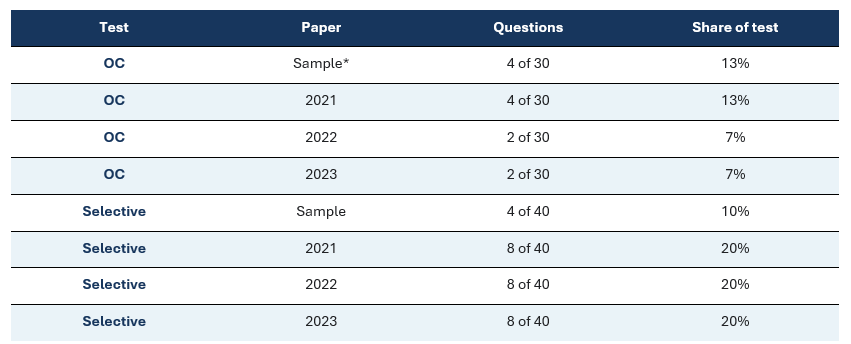
The Selective papers from 2021 to 2023 used this format particularly heavily: eight questions in every 40-question paper. That is one question in every five. In the OC papers reviewed, the proportion ranged from approximately 7% to 13%.
The exact mix can change from year to year, so students should not rely on a fixed number. However, the pattern shows that conditional reasoning, necessary and sufficient conditions, and careful interpretation of words such as “only”, “unless”, “usually” and “must” deserve focused preparation.
A worked example
Consider this rule:
If someone is a gym member, they have access to the swimming pool.
Let:
· A = the person is a gym member
· B = the person has access to the swimming pool
The rule is therefore: If A, then B.
Now consider two speakers:
· Brian: “John has access to the swimming pool, so he must be a gym member.”
· Karen: “John does not have access to the swimming pool, so he cannot be a gym member.”
Brian’s reasoning reverses the rule. The original statement guarantees that gym members have pool access, but it does not say that only gym members have access. John might be a guest, an employee, a swimming student or a member of another facility program. Therefore, B does not prove A.
Karen’s reasoning is valid. If all gym members have pool access, a person without pool access cannot be a gym member. This is called the contrapositive.
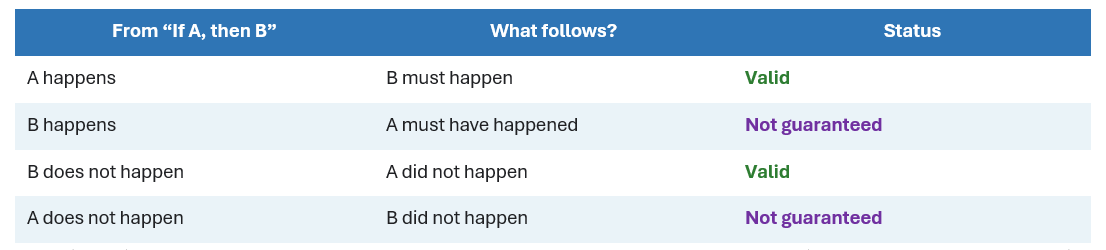
Learning this four-part pattern helps, but students must also understand how ordinary words change the logic.
Six common reasoning errors
1. Reversing the direction of a rule
This is one of the most frequent traps.
Rule: If a student is selected for the choir, the student attends rehearsals.
Incorrect conclusion: Mia attends rehearsals, so she must have been selected for the choir.
Mia may attend rehearsals for another reason, such as accompanying the choir on piano. The rule moves from choir selection to rehearsal attendance, not automatically in the reverse direction.
A useful check is to draw an arrow: selected for choir → attends rehearsals. The arrow does not point backwards unless the information explicitly says it does.
2. Confusing a necessary condition with a sufficient condition
Words such as “only if”, “must”, “required” and “cannot unless” usually introduce a necessary condition.
Rule: A student may enter the robotics competition only if a permission form has been returned.
Returning the form is necessary, but it may not be enough. The student might also need to qualify, pay a fee or be selected for the team.
Incorrect conclusion: Leo returned the form, so he will definitely compete.
Correct conclusion: If Leo competes, then he must have returned the form.
Students should ask two separate questions: Is this condition required? Does this condition guarantee the outcome? The answer may be “yes” to the first and “no” to the second.
3. Treating a tendency or probability as a certainty
The Selective past papers repeatedly tested the difference between probabilistic language and absolute language. Words such as “tends to”, “usually”, “often”, “likely”, “may” and “good chance” allow exceptions.
Statement: Older trees tend to have thicker trunks.
Incorrect conclusion: This tree has a thicker trunk, so it must be older.
The statement describes a general relationship, not a perfect rule. A younger tree might grow in better conditions, or different species may develop differently.
Students should match the strength of the conclusion to the strength of the evidence. “May”, “might” or “probably” can be supported by a tendency. “Must”, “definitely” or “cannot” requires a rule with no allowed exception.
4. Assuming there is only one possible explanation
A conclusion may fail because the speaker ignores alternative causes.
Rule: When the laboratory door is open, a warning light turns on. The light may also turn on during the daily safety test.
Incorrect conclusion: The warning light is on, so the laboratory door must be open.
The light is evidence that something has activated it, but the information gives at least two possible causes. Unless all alternatives are ruled out, the speaker cannot identify one cause with certainty.
This error also appears when someone assumes that a person’s result must have come from one action. For example, advertising leaflets might increase awareness, but strong word of mouth, social media or a community event could do the same.
5. Ignoring extra conditions
Some outcomes require several conditions at the same time.
Suppose an excursion can proceed only if at least 20 students register, enough teachers are available, and transport is confirmed.
Incorrect conclusion: Two teachers are available, so the excursion will definitely proceed.
The speaker has checked only one part of the rule. The other requirements may still fail.
Students should list each condition separately and tick them off. Phrases such as “and”, “as well as”, “on top of that” and “provided that” often signal that more than one requirement must be satisfied.
6. Making a faulty generalisation or category error
A speaker may take a statement about one person, one group or one possible method and extend it too broadly.
Example: Ava improved her spelling without using flashcards. Therefore, flashcards do not help any student.
One experience cannot establish a rule for everyone.
A related mistake occurs with categories: All dolphins are mammals. This animal is a mammal. Therefore, it must be a dolphin.
A Venn diagram makes the problem clear. The dolphin circle sits inside the mammal circle, but the mammal circle also contains many animals that are not dolphins. “All A are B” does not mean “all B are A”.
How words such as “only” and “unless” work
These words often cause difficulty because everyday speech can feel less precise than test logic.
“Only A are B”
This means that anything that is B must be A.
Example: Only registered competitors may enter the warm-up area.
If someone enters the warm-up area, that person must be a registered competitor. However, being registered does not prove that the person entered.
“B unless A”
This can usually be understood as: If not A, then B.
Example: Unless the invitations are posted early, few people will attend.
This guarantees that failing to post early leads to low attendance. It does not guarantee that low attendance proves the invitations were late, because other reasons might also keep people away. However, a large attendance would show that the invitations were not posted late, assuming the rule has been stated as absolute.
Students should be cautious when the statement uses softer language, such as “probably”, “often” or “there is a good chance”. A soft statement does not support a definite conclusion.
A reliable step-by-step method
Step 1: Treat the information in the box as true
Do not challenge whether it is realistic. The question is about what follows from it.
Step 2: Identify the exact rule
Underline logical words such as all, some, none, only, if, unless, must, may, usually, often and definitely.
Step 3: Simplify the rule
Use arrows for conditional rules and circles for categories. For example: competition entry → permission form, or place the “competition entrants” circle inside the “returned permission form” circle.
Step 4: Judge the first speaker independently
Do not compare the speakers yet. Ask whether the first conclusion must follow.
Step 5: Look for a counterexample
Try to imagine one situation in which the statement in the box is true but the speaker’s conclusion is false. If such a situation is possible, the conclusion is not guaranteed.
Step 6: Judge the second speaker independently
Repeat the same process. Do not assume that one must be correct simply because the other is wrong.
Step 7: Match the result to the four options
The possibilities are normally the first speaker only, the second speaker only, both speakers or neither speaker.
Students can build familiarity with these reasoning structures through our NSW OC practice tests and NSW Selective practice tests.
How parents can help at home
Parents do not need to teach formal symbols or advanced logic. Short conversations can build the same habits.
When a child makes a strong claim, ask:
· Does that have to be true, or is it only possible?
· Could there be another explanation?
· Is that condition required, or does it guarantee the result?
· Did the rule actually say “all”, or only “some”?
· Can you think of one counterexample?
You can also practise by turning everyday rules into logic questions:
· Only people with tickets may enter the cinema.
· If the sprinkler is operating, the grass becomes wet.
· Students who complete the challenge receive a certificate.
· The bus is often late when it rains.
Ask the child what can be concluded with certainty and what cannot.
The key lesson
The strongest students do not simply recognise keywords and choose an answer quickly. They control the direction of each rule, preserve the difference between certainty and probability, consider alternative explanations and test each speaker separately.
“Whose reasoning is correct?” questions become much more manageable when students stop asking, “Which person sounds right?” and start asking, “What does the information actually prove?”
Ready to practise?
Create a free account to explore trial OC and Selective Thinking Skills questions, timed practice and detailed explanations.